Monaco is just over two square kilometers, and for most of its perimeter it is not separated from France by so much as a sign. There is no fence, no checkpoint, no stamp. The border runs down the middle of ordinary streets, through roundabouts, along a coastal footpath, and in at least one case through a building. Most visitors cross it several times a day without noticing, which is really the point of this piece: knowing where the line is turns an accidental crossing into something worth paying attention to.
Why the border is where it is
Monaco sits on a narrow shelf of rock and reclaimed land squeezed between the Mediterranean and the hills above Nice. It is bordered by France on every landward side — there is no second country to cross into, only France, in two unconnected directions. To the east and north, the French town of Beausoleil presses directly against Monaco's uphill neighborhoods, sharing the same street grid so completely that the two towns are, in practice, one built-up slope with an invisible seam running through it. To the west, past Fontvieille, the border meets Cap-d'Ail, a much quieter French town that controls the next headland along the coast.
Because Monaco expanded mostly upward and outward through land reclamation rather than by negotiating new territory, its edges are oddly shaped — thin in places, looping in others. This is why a short walk in what feels like one continuous urban area can cross the line two or three times without any change in the pavement.
Crossing on foot, without a sign to tell you
The clearest everyday example is the climb from Monte Carlo into Beausoleil. Several streets on the upper side of Place du Casino simply continue into French territory, becoming Beausoleil streets with French postal codes a short distance up the hill — same buildings, same traffic, different country. There is no gate. A useful way to notice it: French street signs are blue and rectangular, Monégasque ones are a different style entirely, so a quick glance upward at the nearest sign will usually tell you which side of the line you're standing on.
On the eastern edge, near the chapel of Sainte-Dévote, the old route into Monaco from Nice along the Basse Corniche effectively enters the principality at this point — for centuries this was the recognized threshold, long before any modern road layout existed. Walking that stretch today, arriving from the French side, you pass from Roquebrune-Cap-Martin's outskirts into Monaco without any formal marker beyond the change in street furniture and the sudden appearance of Monégasque flags.
The one thing to watch for is assuming the border matches your phone. Mobile carriers sometimes send a "welcome to France" roaming message while you are still standing on Monégasque pavement, and the reverse happens too — the signal footprint of nearby French towers doesn't respect the line any more than the street grid does. It's a minor annoyance rather than a real problem, but it has confused more than one visitor into thinking they've wandered further than they have.
The coastal route into Cap-d'Ail
West of Fontvieille, a marked coastal footpath continues along the base of the cliffs toward Cap-d'Ail, passing below the villas and through small coves that belong first to Monaco and then, a short distance along, to France. This is one of the more pleasant ways to feel the border rather than just read about it: the path doesn't change character, the rock doesn't change color, but at some unmarked point the municipality responsible for maintaining the trail changes, and with it the signage style and the language on the information boards. Cap-d'Ail itself has a small train station and a public beach, and makes a reasonable extension to a day spent around the harbor and Le Rocher, since it requires no particular plan — just a willingness to keep walking past the point where Monaco technically ends.
Looking down on the whole arrangement
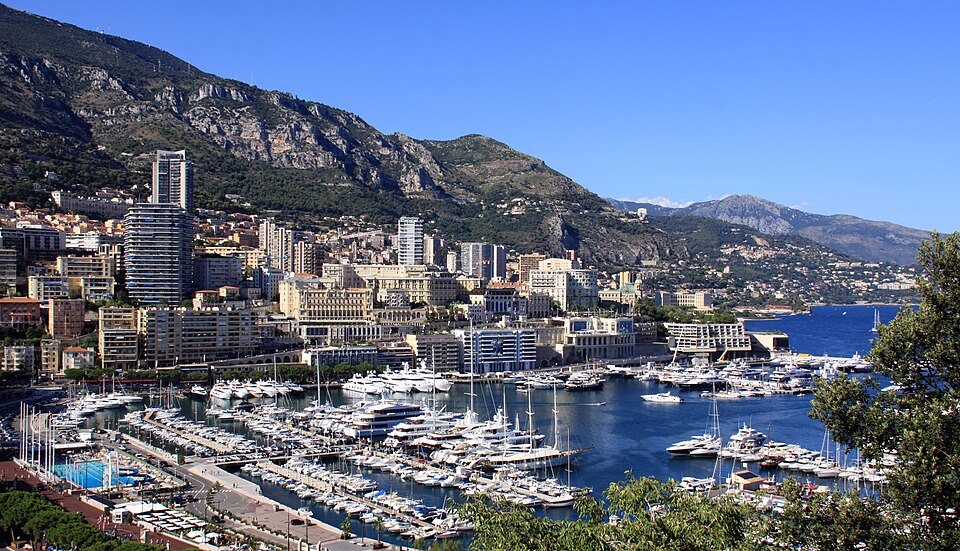
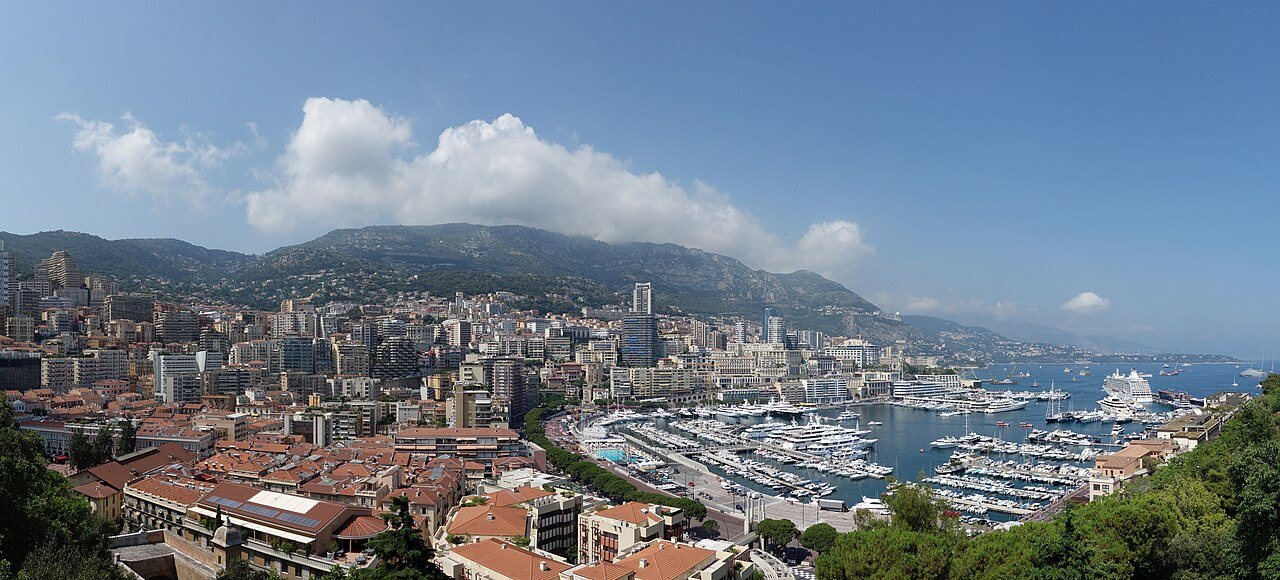
For a view that makes the geography make sense, the French hill town of La Turbie sits directly above Monaco on the Grande Corniche, built around the Trophée des Alpes, a Roman monument marking the ancient boundary of Roman Gaul. From La Turbie's terraces, the line between Monaco and France is not visible as a line at all — Monaco appears as a dense cluster of towers and rooftops wedged against the sea, with Beausoleil's rooftops climbing the slope behind it in exactly the same style of building. It is the single best spot to understand, at a glance, why the two places feel so stitched together at street level: from above, there was never really a gap to cross.
Getting there without overthinking it
None of this requires special planning. Public buses that run through Monaco continue on into France on either end of their routes — toward Nice on one side, toward Menton and the Italian border on the other — and cross the line without any formality beyond a change in the roadside advertising. The same applies to the local bus network described in more detail under getting around, which is generally the easiest way to reach Cap-d'Ail or Beausoleil if walking the whole way isn't appealing. Taxis and private transfers cross just as freely.
What's worth carrying, more than any document, is a basic sense of where you are — because the practical consequences of crossing are real even if the crossing itself is invisible. Shops post prices in euros on both sides, but French public holidays and Monégasque ones don't always match, so a café in Beausoleil might be shuttered on a day when its Monaco counterpart, a hundred meters downhill, is open as usual. Emergency services, postal systems, and local transit tickets are also run separately on each side of the line, even though nothing on the ground tells you when you've switched.
The honest way to think about the border, for a visitor, is less as a line to find and more as a fact to keep in the back of your mind while doing something else entirely — walking to the Jardin Exotique, following the coast path past the harbour, or simply climbing a street that looks like it belongs to one town and turns out, a few steps later, to belong to another.
In pictures