The cathedral on the Rock looks like a church built to be photographed from the outside — pale La Turbie stone, twin towers, a Romanesque-Byzantine silhouette against the sea. Inside, it's quieter and more awkward than people expect, because the thing most visitors have actually come for is a set of floor slabs behind the altar, easy to miss if you don't know where to look.
This is the burial place of the House of Grimaldi, and it has been since the current building replaced the old parish church of St. Nicolas in the late 1800s. Princes, princesses, and consorts are interred here, their names cut into marble set into the floor of the ambulatory, the curved passage that runs behind the high altar. There's no grand mausoleum, no single dramatic monument — just a row of flat stones, plain enough that visitors sometimes walk straight across them without realizing what they're standing on.
Finding Rainier III and Grace Kelly
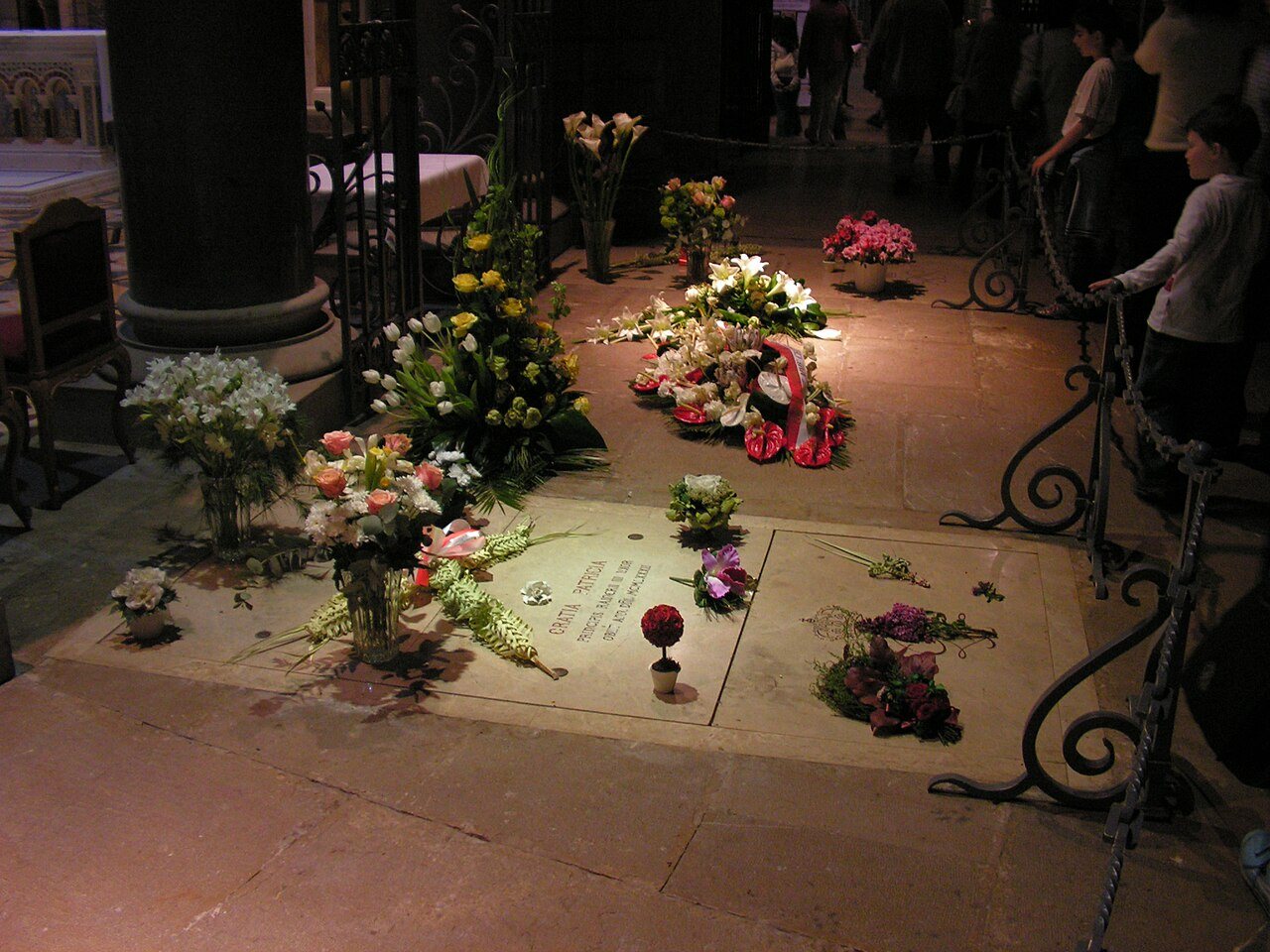
The two tombs everyone is actually looking for are Prince Rainier III, who ruled Monaco for over fifty years, and Princess Grace, the American actress who became his wife in 1956 and died in a car accident on the road above Monte Carlo in 1982. They lie side by side in the ambulatory, among the other Grimaldi graves rather than set apart from them.
Grace Kelly's slab is marked in Latin — Gratia Patricia — rather than in English, which trips people up more than almost anything else in the building. Visitors walk the ambulatory reading names and skip right past it because they're scanning for "Grace." Look for the Latin form, and look at floor level, not at eye level — there's no plaque on a wall, no bust, nothing vertical to catch your eye from a distance.
Flowers turn up on the slab fairly often, left by visitors rather than placed as part of any formal arrangement, and that's usually the fastest way to spot it from across the ambulatory before you can read the inscription.
What else is in the cathedral
The tombs aren't the only reason to go in, even if they're the reason most people do. The building itself dates from the 1870s–1900s, white stone quarried locally, built in a Romanesque-Byzantine revival style that was fashionable for churches of that period around the Mediterranean. The bishop's throne — a white marble chair behind the altar — survives from the much older medieval church that stood on the site before, which makes it older than almost everything else around it.
The altarpiece behind the main altar is a retable attributed to Louis Bréa, a painter associated with the Nice school of the late 1400s, and it's worth the few minutes it takes to walk up and look properly rather than glancing at it from the nave. The cathedral also has a working pipe organ, used for services and for concerts held through the year — if you're planning a visit around one, it changes the atmosphere inside completely, from a tourist stop to an actual working church with an actual congregation.
It is a working church, not a museum, which matters practically: there are services, and during them the ambulatory and the tombs are generally not something you can wander up to and photograph. If a Mass is underway, wait it out somewhere else on the Rock — the cathedral isn't going anywhere, and showing up mid-service to look at a grave is the kind of thing locals notice and don't love.
The Te Deum and why the cathedral matters beyond the graves
Once a year, on Monaco's National Day in November, the reigning prince and the royal family attend a Te Deum service here — a public, formal moment that's as close as the principality gets to a state occasion inside the cathedral rather than outside the Palace. It's a reminder that this building isn't only a historical stop with two famous graves in it; it's still the center of religious and ceremonial life for the ruling family, which is part of why the tombs are treated with more restraint than a typical tourist attraction. There's no ticket turnstile, no audio guide pointed at the grave, no sense that the Grimaldis' burial place has been set up as a show.
Practical notes for visiting
The cathedral sits a short walk from the Palace and the old town, within the same compact stretch of Monaco-Ville that holds most of the Rock's sights, so it's easy to fold into the same visit as the Palace Square and the surrounding streets. Entry works like entry to any parish church open to visitors — there's no admission charge mechanism to navigate, but there are stretches of the day reserved for services when sightseeing isn't appropriate, so check the current schedule with the cathedral directly rather than assuming you can walk in whenever you like.
Dress the way you would for any church visit — covered shoulders, nothing beach-related, which catches out more people than you'd think given how close the cathedral sits to the harbor and the sea. Flip-flops and swimwear are common mistakes in summer, since visitors often arrive straight from the port or a walk along the coast without thinking of the cathedral as a dress-code stop.
Keep your voice down near the ambulatory even if no service is running — it's a small space, sound carries, and other visitors are usually there for the same quiet moment you are. Photography is generally fine in the nave, but be more careful and more discreet right around the tombs themselves; it's someone's grave, not an exhibit case, whatever its historical weight.
If you're building a half-day around the Rock, the cathedral pairs naturally with the Palace exterior, the surrounding old streets, and a stop in the square before heading down toward the Oceanographic Museum at the cliff edge — see itineraries for how people usually sequence it in a single morning.
In pictures